

CAVALLS
WAKAN


Paint Horse
A breed of horse referred to as far back as 500 BC, incorporating color, conformation, and temperament.
The Paint Horse is distinctively versatile and cool. Ideal for anyone who enjoys horses, including beginners.
Paint Horses are loving and easy-going companions, but they will also enthusiastically face the rigors of work or competition.
They are obedient and motivated to please their riders and owners, which makes them easy
to train, while also being healthy and easy to care for horses.
History

In our country, the Ekain Cave in Deva (Guipúzcoa) holds a treasure trove of Paleolithic rock art dating back 14,000 years, where spotted horses have already been observed. Spotted horses have been documented for many centuries in different places around the world. There is an Egyptian painting depicting a red-spotted horse following the Tobiano pattern. There is also the Amphiaraos krater (vessel) (550 BC) depicting a spotted horse. Furthermore, records of classical Athenian cavalry indicate a majority of horses with spotted coats.
More recently, at the Battle of Las Navas de Tolosa, the Muslim leader Muhammad al-Nasser fled on a spotted mare. There are Chinese porcelain and Indian paintings depicting spotted horses.
Spanish explorers first brought the ancestors of the American Paint Horse breed to North America in the 16th century. These horses sported distinctive two-toned and spotted colors. It is believed that the famous explorer, Hernando Cortés, may have brought a stallion to North America from which today's Paint breed is descended. This horse was chestnut and white.
The British began to incorporate the Thoroughbred into the Paint lineage to make a sturdy, stable, and intelligent working horse, and by 1800 the western plains were abundantly populated by free-ranging herds of horses.
Some of these wild horses displayed distinctive markings. Because of their color and performance, these striking, spotted horses soon caught the attention of Native Americans, who admired them for their strength, coat patterns, and friendly personalities. They became the preferred mount of the American Indians. The Comanche, considered the finest horsemen of the plains, kept many spotted horses among their herds. Their preference for this type of horse can be seen in the countless paintings and illustrations of buffalo hide left behind by the Comanche Indians.
It didn't take long for them to start adopting and breeding Paint horses themselves.
Characteristics of the Paint Horse
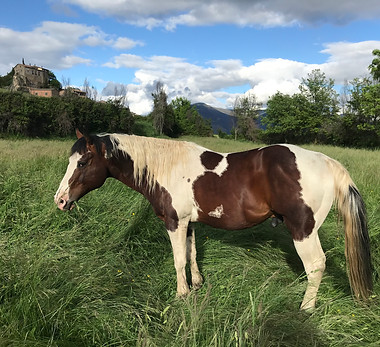
Aside from the color, another unique characteristic of this horse is its constitution; this breed shares the characteristics and structure of the Quarter Horse.
To be specific, it has a firm, muscular neck, a muscular but short back, a strong and well-balanced body with a broad chest and incredibly robust hindquarters, sloping shoulders, medium-sized ears, and intelligent eyes.
They are considered to be among the most robust and muscular horses compared to most lighter horse breeds.
They are medium-sized horses weighing between 450 and 550 kg, with a height between 1.48 and 1.60 m. This height is ideal for most riders, as it is neither too tall nor too short. Those with Thoroughbred heritage are usually on the taller side.
Paint Horses have a calm and friendly nature; they are relaxed and very sociable horses with a natural intelligence and a thirst for learning. Therefore, with proper care, the horse will remain in good mental health, just as important as its physical health, making it a pleasure to ride and train.
It takes more than brains to succeed in competition, and the Paint Horse's work ethic is one more reason why the breed is commonly chosen to compete in various events. They are willing to run repeatedly through a course or perform other tasks, giving their all and displaying impressive endurance even when tired.
They have a very docile and loyal heart, often displaying feelings of attachment to their owner. All of these traits make this breed perfect for beginners.
APHA-Paint Horse Association

Until 1940, when the American Quarter Horse Association (AQHA) was formed, American Quarter and American Paint horses shared a common genetic heritage. However, the AQHA soon excluded from its registry all horses with excessive white in their coat coloration, also known as Paint Horses.
Eventually, the American Paint Horse Association was formed, which maintains the breed registry to promote and preserve it. With approximately 100,000 members in approximately 40 countries around the world, it is currently the second largest breed registry in the world.
To register a new horse with the American Paint Horse Association (APHA), both the sire and dam must be previously registered with the APHA, the American Quarter Horse Association (AQHA), or the Jockey Club (Thoroughbreds). At least one of the two parents must be registered with the APHA. To qualify for Regular Registration, the horse must exhibit a minimum of white hair over a patch of unpigmented skin (pink skin).
However, because the APHA is a breed registry, it doesn't register only horses of a particular color pattern; solid Paint-bred horses are also allowed, and these are referred to as "Solid Paint-Bred." This means that some Paint horses do not have spots or white markings.
What is the difference between a Pinto and a Paint Horse?
Many people often confuse these two words. Simply put, the Paint is a bloodline of horses bred from American Quarter Horses and Thoroughbreds, while Pinto is the irregular or spotted coat color pattern that can be found in multiple breeds. It can be concluded that all Paints are Pintos, but not all Pintos are Paints.


Tobiano

Tovero

White splashed
Color Patterns in Paint Horse
Cada Paint Horse tiene una combinación particular de blanco y cualquier color del espectro equino: negro, bayo, marrón, castaño, pardo, grulla, alazán, palomino, buckskin, gris o ruano.
Mientras que algunos caballos exhiben de manera impresionante dos colores y, por supuesto, blanco, otros pueden tener un pelaje sólido de un solo color y no mostrar ningun patrón ni manchas.
A primera vista, tratar de identificar y nombrar los diferentes patrones de color que se encuentran en American Paint Horses puede parecer un poco intimidante, pero no hay necesidad de alarmarse.
Las marcas pueden tener cualquier forma o tamaño y estar ubicadas prácticamente en cualquier parte del cuerpo y se pueden dividir en tres categorías principales: tobiano, overo y tovero.
Tobiano : El tobiano típicamente muestra blanco sobre su espalda y hasta sus piernas; es común que dos, tres o las cuatro patas de un tobiano sean blancas debajo de los corvejones y las rodillas. Su cabeza normalmente es como la de un caballo de un solo color, ya sea sólido o mostrando una estrella, un recorte, una tira o un resplandor. Sus manchas son regulares y distintas, con bordes claros. Su melena y cola suelen ser de dos colores.
Overo : Con el overo, el blanco se origina en la parte inferior del caballo y rara vez cruza su espalda. Tiende a mostrar color en las cuatro patas. Por lo general, tiene mucho blanco en la cabeza; los overos pueden ser calvos, delantal o bonete. A menudo, uno o ambos ojos serán azules. Cuando el color se encuentra con el blanco, los bordes suelen ser irregulares y las manchas de color pueden estar “bordeadas” (rodeadas por una mezcla de pelos de color y blancos).
Tovero : El caballo tovero muestra características tanto tobiano como overo. Por ejemplo, este caballo puede tener un color tobiano básico, pero con una cara calva o de “delantal”. O bien, podría ser casi todo blanco, mostrando el color base solo en el hocico, las orejas, el pecho y los flancos.
Algunas variaciones del patrón comunes:
Sabino : El sabino tiene un patrón blanco completamente diferente, que generalmente incluye llamas anchas y patas completamente blancas. Algunos tienen tanto blanco que el color puede aparecer solo en las orejas y el pecho (ver la coloración del sombrero de medicina, a continuación), o en la base de la cola. El color de la capa base del sabino no es sólido, sino que está mezclado con pelos blancos.
Blanco salpicado : el blanco salpicado, splashed white, es un patrón de manchas que a menudo hace que el caballo parezca como si hubiera sido sumergido en pintura blanca. Por ejemplo, en un caballo de color oscuro, las patas y la parte inferior del cuerpo suelen ser blancas, con la cabeza blanca y los ojos azules.
Medicine hat: Un gorro de color oscuro en la nuca del caballo se llama gorro medicina, medicine hat. Los caballos que se distinguen por esta marca suelen tener un pelaje predominantemente blanco, a menudo con un patrón de "escudo" oscuro en el pecho. Los nativos americanos creían que estas marcas tenían una protección espiritual especial mientras cabalgaban hacia la batalla.


Overo

Sabine

Medicine hat